Choosing a greenhouse can feel surprisingly difficult. Too small, and tomato vines quickly press against the glass. Too large, and the empty space may become an expensive storage room. This guide explores seven practical greenhouse sizes for new growers, from compact lean-to models to roomy backyard structures.
If you are asking, “what size greenhouse do i need for beginners,” begin with your growing habits. A 4-by-6-foot greenhouse suits herbs, seedlings, and two or three tomato plants. A 6-by-8-foot model offers better working space, shelving, and airflow. For families or serious vegetable growing, an 8-by-10-foot greenhouse may feel more comfortable. Remember the paths. Remember the door swing.
Joe Lamp’l, founder of Growing a Greener World, offers a useful principle: “Start small, but not too small.” That advice matters because greenhouse space disappears quickly. A single cucumber plant can spread across a trellis. A potting bench needs elbow room. You also need space for watering cans, tools, and ventilation equipment. Perhaps beginners often focus too much on floor area. I did, too. Height and usable wall space can matter just as much.
This guide compares dimensions, plant capacity, maintenance demands, and realistic costs. It also considers sunlight, local weather, and future expansion. A greenhouse should support your routine, not punish it. Measure your site carefully. Leave room around the structure. Your first choice may not be perfect. That is normal. The goal is a manageable beginning with enough room to learn, adjust, and grow.
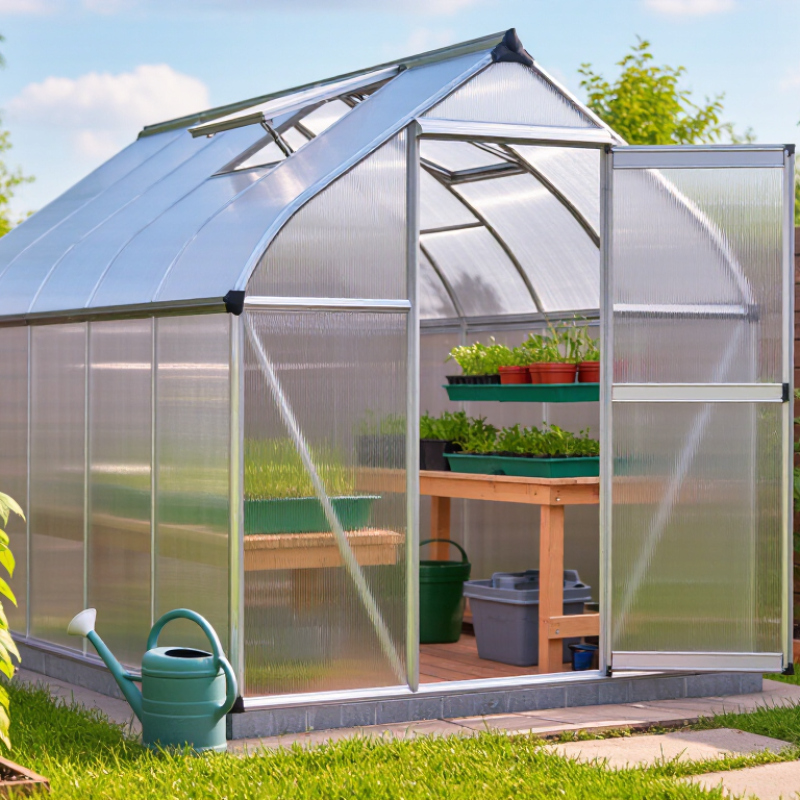
A beginner usually needs a greenhouse that fits daily habits, not ambitious plant lists. A 6-by-8-foot structure offers 48 square feet, enough for seed trays, two narrow benches, and a walking path. A 8-by-10-foot model provides 80 square feet and feels far less cramped during spring transplanting. Leave about 30% of the floor open for movement and watering equipment. Space disappears quickly.
Cornell University greenhouse guidance recommends ventilation capacity near one complete air exchange per minute during hot conditions. This makes width and roof height important, not only floor area. A taller greenhouse improves air volume and heat buffering, while roof vents reduce stagnant humidity. The Royal Horticultural Society also advises positioning structures where they receive strong light and avoid persistent shadows. A small greenhouse in poor light may underperform a larger one in a bright location.
For most beginners, 6-by-8 feet is a practical starting size. Choose 8-by-10 feet if you plan to grow tomatoes, cucumbers, seedlings, and herbs together. Measure your available site first, including door clearance and winter access. I once planned around empty benches. That was optimistic. Shelves, pots, hoses, and airflow gaps consumed nearly every spare inch. A simple floor sketch can prevent that mistake. Check local wind and snow-load guidance before purchasing or building, because climate can matter more than plant quantity.
7 Practical Greenhouse Sizes and Their Best Uses
A 4-by-6-foot greenhouse suits seedlings, herbs, and two or three tomato plants. It fits a balcony edge or small garden, but airflow becomes difficult quickly. A 6-by-8-foot model gives beginners room for shelving, trays, and a narrow path. My first small greenhouse felt generous; it was not. A 8-by-10-foot structure is more forgiving and works well for family vegetables, seasonal propagation, and compact worktables.
Choose a 10-by-12-foot greenhouse when you want tomatoes, cucumbers, peppers, and winter greens together. It supports separate growing zones, though heating costs deserve attention. A 12-by-16-foot greenhouse suits serious home growers, community gardens, or small trial production. The extra width improves movement and reduces accidental plant damage. A 16-by-20-foot greenhouse can support benches, storage, irrigation equipment, and succession planting. It is better for regular harvests than occasional weekend gardening.
A 20-by-30-foot greenhouse fits market testing, cut flowers, or a small protected-crop operation. It needs stronger planning, ventilation, drainage, and labor management. The USDA National Agricultural Statistics Service reported more than 6 billion dollars in U.S. floriculture sales in its 2023 summary, showing the scale of protected horticulture. Yet commercial value does not make a large greenhouse practical for every beginner. University extension guidance repeatedly emphasizes matching structure size with crop plans, climate, and available labor. Measure twice. Leave working space. Many new growers underestimate it.
The best greenhouse size is the largest one your space can support safely, not the largest one available. Measure the clear area, then subtract paths, fences, walls, and doors. Leave at least 60 centimeters around the structure for cleaning and repairs. A cramped greenhouse quickly becomes frustrating.
For beginners, seven useful sizes range from 2 by 2 meters to 6 by 8 meters. A 2-by-2-meter house suits herbs, seedlings, and a sunny balcony corner. A 3-by-3-meter model offers room for shelves and two narrow beds. Larger options, such as 3 by 6 or 4 by 8 meters, support tomatoes, cucumbers, and winter storage. Choose the footprint that leaves space for walking, watering, and ventilation. Sunlight matters too. Avoid placing the greenhouse under trees or beside tall buildings. A south-facing position usually provides strong light, but local heat and wind may change that advice.
Tips: Mark the proposed footprint with string and cardboard. Walk around it with a watering can. Open every door fully. This simple test often reveals problems. I once measured only the floor area and ignored the entrance clearance. The finished layout felt smaller than expected. That mistake was avoidable. Check drainage, nearby electricity, and the route for carrying soil before buying materials. A modest greenhouse with comfortable access usually produces better results than a larger structure squeezed into an unsuitable space.
Choosing the right greenhouse size depends on more than the number of plants you want. I have seen beginners fill a small structure quickly, then struggle with crowded leaves and poor airflow. Measure your growing area, but also consider paths, shelves, water containers, and working space. A greenhouse should leave room for your shoulders and tools.
Your climate strongly affects the ideal size. Hot regions need extra space for ventilation, shading, and air movement. Cold areas may need taller walls, insulated panels, or room for winter protection. Height matters too. A taller greenhouse holds more air and usually manages temperature changes better. Check the site’s sunlight, drainage, wind exposure, and access to water. If you plan to grow tomatoes or cucumbers, allow vertical space and strong support points. Buying only for today can become an expensive mistake. I once underestimated bench space and lost usable floor area to storage.
Tips
Sketch the interior before buying. Mark plant beds, shelves, doors, and walking paths. Leave at least enough room to turn comfortably. Add around 20 percent extra growing space if your budget allows. Measure the site twice. A perfect size on paper may not fit beside a fence, tree, or utility line. Also, review local planning requirements before installation, because size limits can vary by location.
| Greenhouse Size | Floor Area | Recommended Use | Approximate Plant Capacity | Typical Layout | Space and Site Requirements | Main Advantages | Potential Limitations |
|---|---|---|---|---|---|---|---|
| 4 × 6 ft (1.2 × 1.8 m) |
24 sq ft (2.2 m²) |
Starting seedlings, growing herbs, and protecting a small number of seasonal plants. | About 12–24 small pots or seedling trays, depending on shelving and plant spacing. | One narrow central path or perimeter shelves with a small working area. | Requires a level, sunny location with approximately 2–3 ft (0.6–0.9 m) of clearance around the structure for access and ventilation. | Lowest construction and heating cost; easy for beginners to manage. | Limited headroom, storage, work space, and room for tall crops. |
| 6 × 8 ft (1.8 × 2.4 m) |
48 sq ft (4.5 m²) |
A small household collection of vegetables, herbs, flowers, and starter plants. | About 24–48 small-to-medium plants, depending on whether benches or floor beds are used. | Two side benches with a narrow central walkway, or one bench and one planting bed. | Plan for a sunny site of at least 10 × 12 ft (3.0 × 3.7 m), including working clearance and door access. | Compact footprint with enough room to separate seedlings and mature plants. | May become crowded if large containers, tall crops, or extensive shelving are added. |
| 8 × 8 ft (2.4 × 2.4 m) |
64 sq ft (5.9 m²) |
Beginner gardeners who want a balanced mix of propagation, container growing, and small raised beds. | About 30–60 plants, based on crop type, container size, and aisle width. | Two benches or beds along the sides with a central aisle of approximately 2 ft (0.6 m). | A site of roughly 12 × 12 ft (3.7 × 3.7 m) is useful for access, ventilation, and maintenance. | Good all-purpose size with practical circulation and flexible internal organization. | Requires more regular watering, ventilation, and temperature monitoring than smaller models. |
| 8 × 12 ft (2.4 × 3.7 m) |
96 sq ft (8.9 m²) |
Growing vegetables for a small family while maintaining a dedicated seed-starting area. | About 45–90 plants, depending on spacing, crop height, and the amount of bench space. | Two long side beds or benches, a central walkway, and a small propagation shelf at one end. | Allow approximately 12 × 16 ft (3.7 × 4.9 m) of usable site space, plus room for water access and deliveries. | Offers a noticeable increase in productivity without becoming difficult to organize. | More glazing and air volume can increase heating costs in cold climates. |
| 10 × 12 ft (3.0 × 3.7 m) |
120 sq ft (11.1 m²) |
A serious beginner setup with vegetables, flowers, shelving, storage, and an indoor work area. | About 60–120 plants, depending on whether the greenhouse uses intensive beds or wide container spacing. | Two planting beds or benches with a 2–3 ft (0.6–0.9 m) central path and room for vertical crops. | A site of about 14 × 16 ft (4.3 × 4.9 m) helps provide access, drainage, and sufficient working clearance. | Comfortable working area and enough capacity to experiment with several crop types. | Needs stronger planning for ventilation, shading, irrigation, and winter temperature control. |
| 10 × 16 ft (3.0 × 4.9 m) |
160 sq ft (14.9 m²) |
Year-round growing, larger vegetable production, and maintaining separate propagation and growing zones. | About 80–160 plants, depending on plant maturity, bed layout, and crop spacing. | Two long beds or benches, a central aisle, shelving at one end, and space for trellised crops. | Reserve roughly 14 × 20 ft (4.3 × 6.1 m), with good drainage and unobstructed sunlight for most of the day. | Supports succession planting, crop rotation, and multiple growing stages at the same time. | Higher material, maintenance, heating, and cooling requirements; structural strength becomes more important. |
| 12 × 16 ft (3.7 × 4.9 m) |
192 sq ft (17.8 m²) |
Gardeners planning substantial food production, frequent propagation, or a dedicated hobby growing space. | About 100–200 plants, depending on the proportion of floor beds, benches, and large containers. | Two wide side beds, a central aisle, end shelving, vertical trellises, and a small potting or storage zone. | Plan for at least 16 × 20 ft (4.9 × 6.1 m), with suitable foundations, drainage, wind protection, and service access. | Most flexible option in this list; provides room for tools, work surfaces, and long-term expansion of skills. | May be excessive for casual use and can require supplemental heating, automated ventilation, or irrigation. |
Planning note: Plant capacity is an approximate estimate rather than a fixed limit. The ideal greenhouse size depends on available sunlight, local climate, intended crops, walkway width, bench depth, equipment, budget, and whether the structure will be used seasonally or year-round. Keep the greenhouse away from persistent shade, provide reliable water access, and leave enough clearance for ventilation and maintenance.
Choosing a greenhouse size starts with plant needs, not empty garden space. USDA’s 2023 Floriculture Crops Summary valued U.S. floriculture production at about $6.7 billion. That scale reflects serious planning around protected growing. Beginners can apply the same principle on a smaller level.
A 6-by-8-foot greenhouse suits seedlings, herbs, and several tomato plants. It usually fits two narrow beds with a central walkway. A 8-by-10-foot model offers better shelf space and easier movement. Keep at least 24 inches for walking. Shelves should stay near the walls, leaving sunlight above the plants. Measure mature plants, not seed packets.
I once underestimated tomato height and blocked a full shelf. It was an avoidable mistake. Plan 30 to 36 inches of vertical clearance for tall crops. The USDA’s 2022 Census of Agriculture reported $18.3 billion in horticultural sales, showing how valuable productive space can become. Leave one wall open for future expansion. If you expect more trays, choose 8-by-12 feet instead. A small greenhouse feels efficient until watering cans, tools, and winter pots arrive. Allow room for them. Shelves can be added later, but widening the structure is rarely simple.
A 6-by-8-foot greenhouse is a practical starting point. It provides 48 square feet for trays, benches, and a narrow path. Keep about 30% of the floor open for movement. Space disappears quickly.
Choose 8-by-10 feet for tomatoes, cucumbers, seedlings, and herbs together. Its 80 square feet feels less crowded during spring transplanting. You will have more room for shelves, pots, and watering equipment.
Yes. It suits herbs, seedlings, and two or three tomato plants. It works near a small garden or balcony. However, airflow becomes difficult quickly.
This size supports tomatoes, cucumbers, peppers, and winter greens together. Separate growing zones become possible. Heating costs may increase, so consider your local climate.
Leave at least 60 centimeters around the structure for cleaning and repairs. Also check door clearance, paths, fences, and walls. A cramped greenhouse becomes frustrating.
Mark the area with string and cardboard. Walk around it with a watering can. Open every door fully. This simple test often reveals problems.
Not always. A taller structure holds more air and buffers temperature changes. Roof vents also reduce stagnant humidity. Width affects movement and airflow.
Choose a bright location away from persistent shadows. Avoid trees and tall buildings. A south-facing position often provides strong light, but local wind and heat may change that.
Many measure only the floor area. Shelves, hoses, pots, and entrance clearance consume extra space. I made that mistake once. The layout felt smaller than expected.
Choosing the right greenhouse size is an important first step for any beginner. If you are asking, “what size greenhouse do i need for beginners,” start by considering your available space, gardening goals, budget, and the types of plants you want to grow. Small options are suitable for herbs, seedlings, and a few seasonal crops, while medium and larger structures provide room for vegetables, flowers, work areas, and better airflow. The ideal size should fit comfortably in your yard without blocking paths, sunlight, or access for maintenance.
This guide explores seven practical greenhouse sizes and explains the best use for each one. It also shows how to measure your space, account for shelves and walkways, and plan around factors such as ventilation, plant height, weather, and daily access. Beginners should avoid filling every corner immediately and leave space for watering, pruning, and future expansion. A slightly larger, well-organized greenhouse can often be more useful than a cramped structure that limits growth and flexibility.

Beamer Garden