A garden shed can look solid on a calm afternoon, then shift when gusts hit its broad walls. Even a small movement can loosen a door, twist the frame, or let rain creep beneath the floor. Learning how to anchor a garden shed without concrete starts with the ground beneath it. Soft soil, a sloping yard, and freeze-thaw cycles all affect which fixing will hold. There is no single perfect solution. A method that works in compacted gravel may fail in wet, loose soil.
This guide explores seven practical options, including ground screws, earth anchors, timber skids, and paving slabs. Each has different strengths, costs, and installation demands. The right choice depends on your shed’s size, its base, and the weather it faces. Check the manufacturer’s instructions before attaching anything to the frame. Look for buried utilities before driving anchors into the ground, and confirm that the base sits level. Small details matter. A loose strap or shallow anchor can defeat an otherwise sturdy setup. Some methods also need periodic checks, especially after storms or when the soil becomes saturated. The advice here is a starting point, not a substitute for site-specific judgment. Measure carefully, use suitable hardware, and reconsider the plan if the ground feels unstable. A little extra care now can prevent a shed from rocking later.
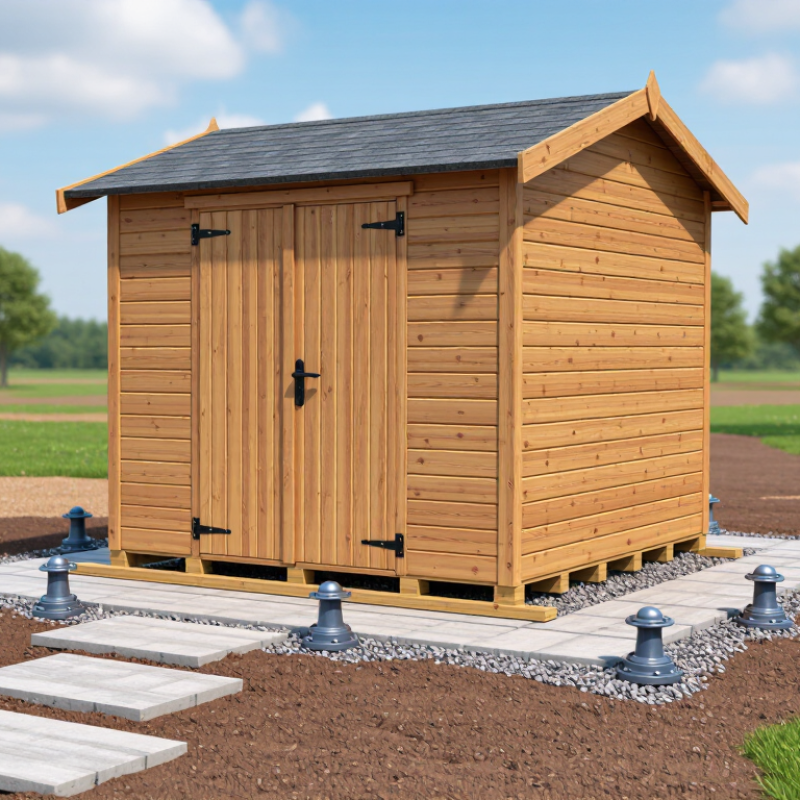
A shed’s weight helps determine its anchor needs, but it does not tell the whole story. A lightweight shed can catch strong gusts like a sail, while a heavier one may still slide or tip on loose ground. Check the manufacturer’s empty weight, then consider stored tools and seasonal contents. More weight is not a substitute for secure anchoring.
Soil matters. A hand-dug test hole can reveal loose fill, dense clay, or gravel, though one small hole may not represent the whole site. Note drainage and frost depth, too; wet or frozen ground can reduce an anchor’s holding power. Match ground screws, earth augers, or driven anchors to the soil and follow their installation guidance. It takes a little checking.
For wind, ASCE 7-22 provides methods for evaluating site-specific loads, including wind speed, terrain exposure, and topographic effects. The applicable design can also depend on the shed’s size, shape, and risk category. Check which standard and local requirements apply in your area; adoption may vary. A hilltop or open field can face greater wind exposure than a sheltered yard. Small sheds are easy to underestimate. If the site is exposed, the soil is uncertain, or the shed is large, ask a qualified building professional to review the anchoring plan.
Before anchoring a shed, find your jurisdiction’s adopted frost-depth value. The 2021 International Residential Code (IRC), Table R301.2(1), lists frost-line depth as a local design criterion; it does not set one depth for every U.S. location. IRC Section R403.1.4.1 generally requires conventional footings to extend below the established frost line. Local amendments and permitted exceptions may change what applies to a small shed. Check the building department’s published criteria before selecting ground screws or earth anchors.
This matters because frost heave can lift one corner while the opposite side stays put. A sloping floor, a door that scrapes, or a loosened anchor may follow. Measure the site, note soil type and drainage, and compare your plan with the local requirement. An anchor’s required depth is not automatically identical to a footing depth; ask the authority having jurisdiction when the code is unclear. That extra check can prevent a costly guess.
Tips: Keep the shed base level, direct roof runoff away, and install anchors in firm, undisturbed soil. Photograph the depth measurement before backfilling. Small detail, big help. Even careful builders can misread a frost-depth chart, so record the source and date you checked it.
Ground screws are a practical choice for small sheds on firm, relatively level soil. Their broad threads bite into the ground as they are turned, and brackets at the top can hold skids or a timber frame. Installation is quick when the soil is workable. Rocky ground can stop a screw early, though, and a partly seated screw may feel secure before it shifts under a gust.
Helical anchors use one or more steel plates along a shaft. The plates are driven or twisted deeper, where undisturbed soil can provide stronger resistance to uplift. They suit exposed sites and heavier sheds, but correct depth matters. A professional installer can check installation torque, a useful indicator of soil resistance. Still, torque alone does not tell the whole story. Soil layers vary more than a neat diagram suggests.
Driven earth augers use a blade or plate on a shaft, driven into the soil and connected to the shed with a strap or cable. They can work well in compact, consistent ground and are often less involved to install. Loose fill, wet soil, or shallow bedrock can reduce their holding power. The terms can overlap between products, so compare the actual shaft, plate, and rated load—not just the label. Check for buried utilities, follow the shed maker’s anchoring requirements, and inspect the supports after the first strong wind. A small alignment error is easy to miss.
| Anchoring method | How it works | Most suitable ground | Typical uplift resistance | Installation effort | Best suited for | Main limitations |
|---|---|---|---|---|---|---|
| Structural ground screws | Large steel screws are turned into the ground and connected to the shed base or supporting frame. | Firm, reasonably clear soil; performance varies with soil type and screw size. | Moderate to high when correctly sized, installed, and connected. | Moderate; installation may require a drive tool or powered equipment. | Permanent sheds that need both ground support and secure attachment. | Stones, roots, very hard ground, and shallow bedrock can prevent proper installation. |
| Helical anchors or piles | One or more steel helix plates are rotated into the soil; the shaft is attached to the shed or its foundation frame. | Soils that allow the helix to be installed to the required depth; capacity depends on the soil profile. | High potential when engineered and installed to the required depth and torque. | High; larger systems often need specialist installation equipment. | Larger or heavier sheds and sites where wind uplift is a significant concern. | Installation and capacity need proper assessment; obstructions and rocky ground can be problematic. |
| Driven earth augers | A screw-shaped anchor is rotated into the soil and connected to the shed with a cable, rod, or strap. | Loam and other penetrable soils without major buried obstructions. | Moderate for many small sheds; varies with anchor size, embedment, and soil. | Low to moderate; some models can be installed with a hand tool. | Light to medium sheds needing a straightforward tie-down against wind uplift. | Less effective in loose, rocky, frozen, or waterlogged ground; ties must connect securely to the frame. |
| Driven steel ground stakes | Long steel stakes are driven through base-frame anchor points or brackets into the soil. | Compact soil that can be penetrated without hitting rocks or buried services. | Low to moderate; generally less resistant to uplift than properly installed screw or helical anchors. | Low; typically needs a sledgehammer and suitable brackets. | Small, lightweight sheds on firm ground. | May loosen in soft soil and can be difficult to remove or drive in stony ground. |
| Buried deadman anchors | A buried timber or metal plate is connected to the shed with a rod, cable, or strap; surrounding soil resists pullout. | Excavatable soil that can be compacted around the buried anchor. | Moderate to high when adequately sized, buried, and connected. | High; requires digging, accurate placement, and secure connections. | Sites where screw-in anchors are unsuitable but excavation is practical. | Labor-intensive and harder to inspect or adjust after backfilling. |
| Driven plate anchors | A narrow anchor is driven into the soil and then set so its plate turns across the direction of pull. | Soil that accepts the drive rod and allows the plate to set correctly. | Moderate to high, depending on plate size, depth, soil, and installation quality. | Moderate; installation usually involves a drive rod and a tensioning step. | Sheds needing concealed tie-downs with limited surface hardware. | Incorrect setting can greatly reduce holding capacity; unsuitable where rocks block the drive path. |
| Anchored timber skids or runners | The shed sits on treated timber runners, which are secured to the ground with suitable earth anchors and straps or brackets. | Level, well-drained ground with soil suitable for the selected anchors. | Varies; the anchor connections and skid-to-shed attachments determine overall resistance. | Moderate; requires a stable base and secure connections at multiple points. | Small to medium sheds that need a raised, relocatable base without a poured footing. | Skids alone do not prevent uplift; timber can deteriorate if it stays wet or is not rated for ground contact. |
Note: These are general comparisons, not load ratings. Choose anchors for the shed’s size, weight, frame, local wind exposure, soil conditions, and applicable building requirements. Follow the anchor manufacturer’s installation instructions and check for buried utilities before digging or driving anchors.
A shed can shift even when its skids look heavy. Start by checking the soil: stakes hold best in firm ground, not loose fill or saturated earth. Before digging for buried deadman anchors, check for underground utilities. A buried anchor should sit across the direction of pull, with a rated tie-down running from it to a solid skid or frame connection.
Drive stakes beside the skids at the corners, and add support along long sides where wind exposure is high. Angle each stake away from the shed, then attach rated straps or cables without sharp bends. Follow the hardware’s load rating; a strong strap is only as reliable as its weakest connector. Keep tension even on both sides. Too much pull can twist a skid or rack the door opening. I learned that the hard way.
Deadman anchors suit softer ground, but their holding power depends on burial depth, soil, and installation. Stake systems are simpler to inspect. Neither is foolproof. After the first heavy rain or wind, check for loosened soil, slack straps, and movement at the shed corners. Recheck seasonally, since soil settles and wood changes shape. A quick inspection matters.
A planning illustration showing four anchor points—one at each corner—for each method. The appropriate anchor type and quantity depend on shed size, soil, exposure, and local requirements.
Four points are shown for comparison only, not as an engineered specification. Follow the anchor and shed manufacturers’ instructions, and check local wind-load requirements.
Before choosing anchors, check the shed’s expected loads and the ground beneath it. Wind can lift a light shed, while wet or loose soil can reduce an anchor’s holding strength. Compare each anchor’s rated capacity with the required uplift and lateral loads; do not treat a product rating as proof that it will hold in every soil type. When soil conditions are uncertain, ask a qualified local professional to assess them. A quick hand test is not enough.
Follow the shed instructions and local building requirements for anchor count, spacing, and installation depth. Anchors often go near corners and along the base, but spacing depends on the structure and its exposure. Keep them aligned with the skids or frame, and avoid placing one where it could split a board. Measure before drilling. Slightly awkward, but worth it.
Corrosion protection matters where anchors meet damp soil, treated lumber, or standing water. Confirm that the anchor coating or material is suitable for those conditions, and use compatible fasteners to reduce corrosion between dissimilar metals. Inspect the connections after installation and periodically afterward. Look for rust, loose nuts, bent rods, or wood pulling away from the base. Codes and soil conditions vary by location, so verify the applicable requirements before installation.
They work well in firm, fairly level soil. Their broad threads turn into the ground and support shed skids. Rocky ground can stop them early, and a partly seated screw may shift in strong wind.
Helical anchors have steel plates along a shaft that reach deeper soil. They can suit exposed sites and heavier sheds. Installation torque helps assess resistance, but soil layers still vary.
They can hold well in compact, consistent ground and are often simple to install. Loose fill, wet soil, or shallow bedrock can reduce their holding power. Check the actual plate and rated load.
They can help, but their strength depends on burial depth, soil, and installation. Place the anchor across the direction of pull, then connect it to a solid skid or frame.
Place them near the corners and add support along exposed long sides. Angle each stake away from the shed, then attach rated straps or cables without sharp bends. I learned that the hard way.
Compare each anchor’s rated capacity with expected uplift and lateral loads. Follow shed instructions and local requirements for number, spacing, and depth. A product rating alone cannot promise a secure hold.
Check for buried utilities before digging. Confirm that soil conditions suit the anchor, and ask a qualified local professional when they are uncertain. A quick hand test is not enough.
Look for rust, loose nuts, bent rods, slack straps, or wood pulling away from the base. Check again after heavy rain or wind, then inspect seasonally. Small alignment errors matter.
Anchoring a garden shed without concrete starts with understanding the shed’s weight, the soil beneath it, and the wind exposure at the site. These factors help determine how much uplift and lateral force the anchoring system must resist. Prepare a firm, level base, and account for locally applicable frost-depth guidance so seasonal ground movement is less likely to disturb the shed.
Several options can secure a shed without a concrete slab, including ground screws, helical anchors, driven earth augers, and deadman anchors. Skids may also be fastened with suitable stakes and rated tie-downs. The best approach to how to anchor a garden shed without concrete depends on the structure and site conditions. Check anchor capacity and spacing against the expected loads, use corrosion-resistant components suited to the environment, and confirm that the installation meets relevant building requirements.

Beamer Garden